
Introduction
Robert Oppenheimer, when he had his security clearance questioned and then lifted when he was being punished for having resisted the development of the hydrogen bomb, was asked by the interrogator at this security hearing — “Well, Dr. Oppenheimer, if you’d had a hydrogen bomb for Hiroshima, wouldn’t you have used it?” And Oppenheimer said, “No.” The interrogator asked, “Why is that?” He said because the target was too small.1
1 Recounted by Richard Rhodes, https://www.dwarkesh.com/p/richard-rhodes
The optimistic case for AI suggests that we are on the verge of a new industrial revolution, with productivity gains that could rival or exceed those of the 19th and 20th centuries. The most bullish claimants argue that AI will ultimately automate all human labor, leading to a post-scarcity economy where material needs are easily met and leading people to focus on non-economic pursuits.
This vision assumes that if we can produce a superabundance of goods and services, there will automatically be demand to consume them. The opposite problem is also possible: we could develop the capacity to produce more than people want or can afford to buy. Supply must be justified by demand before it creates value.2 In this essay, I will argue that productive capacity does not automatically produce proportionate economic growth (and increased capacity may even cause instability in the short term), because the demand chains that convert supply into broadly distributed income may compress faster than they regenerate.3
2 This is not a moral argument against AI. Running into demand constraints is a good problem to have, as it means we can produce more than we can sell, which is a sign of prosperity. This essay argues that even though the supply of intelligence will increase, the demand for intelligence may not automatically scale as smoothly, leading to problems. AI does not automatically create explosive growth, because cheaper cognition only matters economically when it can be absorbed into trusted, discoverable, payable, attention-worthy demand chains.
3 I hold this view at maybe 60% confidence, not 90%. The mechanism feels right, but the magnitude and timing are where I’d most expect to be wrong. There also seems to be a lot of room for idiosyncratic demand that people aren’t currently expressing. If conditions shifted enough to surface those wants, the saturation argument would be weaker than I’m claiming here.
Wants vs. Demand
“One thing I love about customers is that they are divinely discontent. Their expectations are never static – they go up. It’s human nature.”
— Jeff Bezos4
4 https://www.aboutamazon.com/news/company-news/2017-letter-to-shareholders
Everyone wants better health, nicer housing, more entertainment, and better futures for their children. Due to hedonic adaptation, people continually grow accustomed to higher standards, and therefore desire new and better things. But wants are not the same as demand.
In order for wants to become demand, the wanters need to be able to discover the product or service, trust that it will meet their needs, and pay for it. Throughout this essay, I will use “demand” in this broader sense, not merely as “desire”, but as the full ability to discover, trust, afford, and spend attention on a want. If ten million people need housing but cannot pay their rents or property taxes, the housing market reads this not as “enormous unmet need” but as “weak demand at this price.” If people want to fly, but believe Boeing planes will crash, the airlines will not make money, as people will judge the risk of the service too high. If a million people want to read this article, but Google doesn’t show it in search results and they never find it, then the value is not realized.
Jean-Baptiste Say, the 19th-century French economist, argued that the act of production generates income, which in turn creates purchasing power, and therefore demand.5 When wages and production are tightly coupled, this can be true. But when income concentrates, or when the link between production and wages weakens (for example, due to automation), it is possible for supply to outpace demand. In such cases, the economy can produce more than it can sell, leading to deflationary pressure (which in turn tends to cause economic stagnation).
5 Often Say’s Law is framed as “supply creates its own demand,” but this is a mischaracterization.
6 Oil economies are a classic example of this phenomenon. They can produce enormous wealth from oil exports, but if that wealth is concentrated in the hands of a few elites, and the rest of the population has limited purchasing power, then the economy can fail to grow. As I examined in my article on selectorate theory, the political structure of such economies often tends to concentrate power as well, leading to totalitarianism. Structurally, these problems are likely to be exacerbated by AI as well. We will see a similar pattern in China, which is not an oil economy, but IS a relatively centrally planned economy, and also has a similar problem of overcapacity and demand constraints. The form of the government and the structure and performance of the economy are intertwined.
For example, imagine an economy where a small elite produces a vast amount of goods and services, but the majority of the population has little to no purchasing power6. The elite can only consume so much, and the rest of the population can’t afford to buy what is produced. In this scenario, supply far exceeds demand, leading to overcapacity and deflation. The economy likely stagnates; without buyers, most goods and services produced go unsold, meaning the value is not realized. Additional, if future investment is not worthwhile, the economy begins to shrink.
China
We can see overproduction affect economies in practice. Consider China. In July 2024, the Chinese Politburo declared the need to “strengthen industry self-regulation in order to prevent vicious ‘involutionary’ competition”. By December, the Central Economic Work Conference escalated to calling for “comprehensive rectification.” By March 2025, delegates were lining up to denounce “bottomless price wars, bandwagon-style competition, and talent poaching.”7
7 See Patricia Thornton, “Punching Down: Beijing’s Playbook for Unwinding ‘Involutionary Competition,’” China Leadership Monitor (December 2025), https://www.prcleader.org/post/punching-down-beijing-s-playbook-for-unwinding-involutionary-competition. See also Michael Pettis, “What’s New about Involution?,” Carnegie Endowment (2025), https://carnegieendowment.org/europe/posts/2025/08/whats-new-about-involution.
8 China produced about $4.7 trillion in manufacturing value added in 2024 (roughly 28 percent of global output), compared to $2.9 trillion for the United States, around $1.05 trillion for Japan, and around $770 billion for Germany. Together, the next three roughly equal China’s total. Data from the United Nations Industrial Development Organization (UNIDO), https://stat.unido.org.
Why is the world’s second-largest economy, with a huge population and the largest industrial base (roughly the size of the next three largest manufacturers combined8), facing economic stagnation? And why is the Chinese government cracking down on competition between domestic firms?
The problem is not insufficient supply, as China produces more than enough to meet its own needs. The problem is that the Chinese economy, which is built on export-led growth and investment-driven expansion, has created a situation where productive capacity exceeds accessible demand. More precisely, the problem is not that China lacks wants in the abstract, but that state-guided investment has built capacity in sectors where accessible, creditworthy demand is not large enough to validate the capital stock. For example, China’s steel industry has a capacity of roughly 1.2-1.3 billion tons per year, but domestic demand is only around 900 million tons. The result is chronic overcapacity, with the ferrous metal smelting, rolling, and processing sector operating at around 78.5% utilization in H1 20249.
9 Capacity estimates from S&P Global Commodity Insights (2024). Domestic apparent steel consumption was about 934 million tons in 2023 and continued to decline through 2024, per CREA and CEIC data. Utilization figure from China Iron and Steel Association data reported by SteelOrbis.
10 Obviously, punishing the Chinese economy is the express purpose of the tariffs. China faced a record 160 trade investigations in 2024, up from 69 in 2023, with developing countries joining developed ones in erecting barriers (per China’s Ministry of Commerce data reported by the South China Morning Post). While Trump is often credited with the trade war, the Biden administration also instituted tariffs on Chinese goods such as steel, aluminum, solar panels, and electric vehicles. The second Trump administration has also been pressuring allies to limit Chinese access to markets, with the EU and UK following suit. The result is that China’s export-driven growth model is under attack. We can think of tariffs through the lens of “demand-chain warfare”, the inverse of supply-chain warfare. Supply-chain warfare restricts access to inputs (chips, rare earths, energy). Demand-chain warfare restricts access to customers. There are many demand-side analogies to concepts from supply-chain warfare. For example, Russian oligarchs routing yacht purchases through intermediary countries to evade sanctions can be thought of as demand-chain transshipping, the informational analog of supply-chain transshipping to avoid tariffs. Similarly, just as supply chains are “friend-shoring” (redirecting physical flows to allied nations), demand chains are localizing regionally around local data and consent regimes. Hence, the US government’s threats to restrict Chinese access to US consumer markets, and the EU’s moves to limit Chinese access to the European market.
11 See Michael Pettis, “China’s Capacity Limits: A Necessary Evil,” Carnegie Endowment (2025).
Typically, China exports the surplus, but global demand has also weakened, and increasing trade barriers make it harder to sell the excess abroad10. As a result, many Chinese firms are losing money. Firms compete for a dwindling number of buyers by cutting prices, which further erodes margins and discourages investment in new capacity. The same pattern holds across multiple sectors, including coal, cement, aluminum, solar panels, and electric vehicles. The Chinese government is trying to address the problem by cracking down on competition and, in some cases, by implementing capacity limits11. In a textbook market, falling prices would clear the excess, but here the problem is that debt, subsidies, sticky wages, and political resistance to firm failure can keep capacity alive after the price signal has already said to stop.
The electric vehicles sector is illustrative. The number of NEV brands selling in China has collapsed from over 500 in 2018 to 129 in 2024, with AlixPartners projecting that only about 15 will remain financially viable by 203012. Similarly, solar panel giants like Jinko and Trina saw profits plunge 69% and 85% respectively in the first half of 2024 despite dominating global markets13. In response, the Chinese government has imposed production caps and is encouraging consolidation among existing firms.
12 The 2018 figure of over 500 NEV companies in development is widely reported in industry coverage. The 129-active-brands figure for 2024 and the 15-by-2030 projection come from the AlixPartners 2025 Global Automotive Outlook.
13 Reported in PV Magazine’s September 2024 industry brief on H1 2024 results.
The underlying issue is that the Chinese economy is producing more than it can sell, resulting in deflationary pressure. To make matters worse, in the Chinese system investment is often driven by state-owned enterprises and local governments. This not only incentivizes capacity buildout to meet centralized growth targets without regard for the demand of the output, but also makes it politically difficult to shut down unprofitable firms.
If unprofitable companies are not efficiently eliminated, the economy ends up with “zombie firms”, chronically unprofitable companies kept alive by subsidized credit. The zombie firm problem creates a vicious cycle, where unprofitable firms continue to occupy capital, land, and labor, crowding out more productive entrants.14
14 From 2008 to 2018, China’s nonfinancial corporate debt grew from roughly $4.4 trillion to over $21 trillion, a roughly fivefold increase, per BIS data. The IMF’s 2016 working paper on China’s corporate debt estimated loans at risk (loans to firms whose interest coverage ratio was below one) at about 15.5 percent of nonfinancial corporate borrowing. In late 2025, the Dallas Fed estimated that the zombie share of all Chinese non-financial firm assets rose from 5 percent in 2018 to 16 percent in 2024.
15 The phenomenon of “ghost cities” in China, where entire urban developments remain largely unoccupied, is a stark illustration of the overcapacity problem. These cities were built in anticipation of demand that never materialized, leading to vast swaths of empty apartments and commercial spaces.
16 Atlantic Council, “China’s Property Slump Deepens — and Threatens More Than the Housing Sector,” February 2026, https://www.atlanticcouncil.org/blogs/econographics/chinas-property-slump-deepens-and-threatens-more-than-the-housing-sector/
17 J. Scott Davis and Brendan Kelly, “China Debt Overhang Leads to Rising Share of ‘Zombie’ Firms,” Federal Reserve Bank of Dallas, December 2025, https://www.dallasfed.org/research/economics/2025/1223
In particular, China’s property market has undergone a five year slump. China built a huge inventory of housing15, resulting in an estimated 80 million unsold or vacant homes, with roughly 85% of the post-2021 price gains erased16. The real estate collapse has crushed household wealth, suppressed consumer confidence, and increased the concentration of zombie lending. The Dallas Fed reports that the zombie share of Chinese real estate sector assets has risen from about 6 percent in 2018 to 40 percent in 2024, consistent with the property sector’s extended downturn17.
These trends parallel some of the trends in Japanese economy18 since the 1990s. In that case, “evergreen” lending, where banks extended new loans to cover old bad debt, created zombie banks alongside zombie firms. This led to a sharp slowdown in productivity, and poor Japanese economic performance for three decades. China seems to be following a similar path, with the government providing subsidized credit to keep unprofitable firms afloat. We can expect similar long-term stagnation if the underlying demand problem is not resolved.
18 See for example, https://www.chicagobooth.edu/review/zombie-lending-japan. Japan’s issues were caused by a real estate and stock market bubble that burst in the early 1990s, leading to a banking crisis. The government subsequently misallocated resources, propping up zombie banks and firms. This led to a prolonged period of economic stagnation. Once the supply-side became distorted, households whose wealth was destroyed by the asset collapse stopped spending, which made consumers delay purchases. In turn, real wages fell, creating a deflationary spiral. This was also exacerbated by an aging population. Japan had the capacity to produce, but no one was buying. China’s issues are similar but generated via a different mechanism.
Tariffs aside, does China lack domestic demand to absorb its own production? Household income is a low share of GDP, and weak social safety nets drive precautionary saving. The Chinese government has tried to stimulate demand by artificially increasing wages and providing subsidies, but this is also a distortion that risks fueling inflation without necessarily creating sustainable demand for goods and services.
The underlying cause of the Chinese demand creation problem is the lack of liberalism. By liberalism here I mean less a moral slogan than a cluster of institutions (firm failure, legal trust, consumer credit, social insurance, and decentralized experimentation) that help private wants become effective demand. Demand creation requires millions of individuals and firms independently identifying what they think is valuable. Centralized economies are good at building supply to meet centralized targets. But the wants of a government are not the same as the wants of the individuals within a state. Liberal democratic institutions tend to support consumer credit markets, social insurance that obviates the need for precautionary saving, and legal protections that encourage entrepreneurial risk. While Western systems haven’t fully solved the problems of demand creation (as we will discuss in later sections), they are much more effective at allowing individuals to have their wants recognized and satisfied19. Furthermore, Western systems tend to be more willing to allow firms to fail, which is a necessary part of the process of creative destruction, reallocating resources to more productive uses. In contrast, China’s system of state-owned enterprises and local government investment creates a situation where supply can outpace demand without the usual market mechanisms to correct it.
19 Democracies often have a different problem, where instead of the governments overruling the wants of the people, the people’s individuated wants conflict, leading to collective action problems. This leads to issues like NIMBYism, regulatory capture, congressional gridlock, and other forms of political dysfunction. However, even with these issues, the democratic system still allows for a more dynamic and responsive demand creation process compared to a centralized system like China’s.
20 Another option is to weaken the currency to boost export competitiveness, but this risks tariff escalation and may not be effective if global demand is weak. Alternatively, strengthening the currency could support domestic purchasing power, but it would further erode export margins. Neither direction resolves the fundamental problem, which is too much productive capacity relative to accessible demand.
21 Could China redirect exports to the developing world, i.e. Africa? African per capita income is low, the markets are fragmented with poor logistics, and many countries are already stressed by Chinese debt. For China to generate meaningful endogenous demand in Africa, it would need sustained growth, urbanization, a growing middle class, and regional integration. None of these are happening fast enough to absorb Chinese overcapacity.
China’s remaining options are limited. Weakening the currency boosts export competitiveness but triggers tariff retaliation20. Redirecting exports to developing markets like Africa runs into low per capita income, fragmented logistics, and existing debt stress21. And the Chinese social order disincentivizes the structural reforms needed to build a robust domestic consumer market.
Industrial Revolution in Britain
Our need will be the real creator.22
22 From Plato’s Republic.
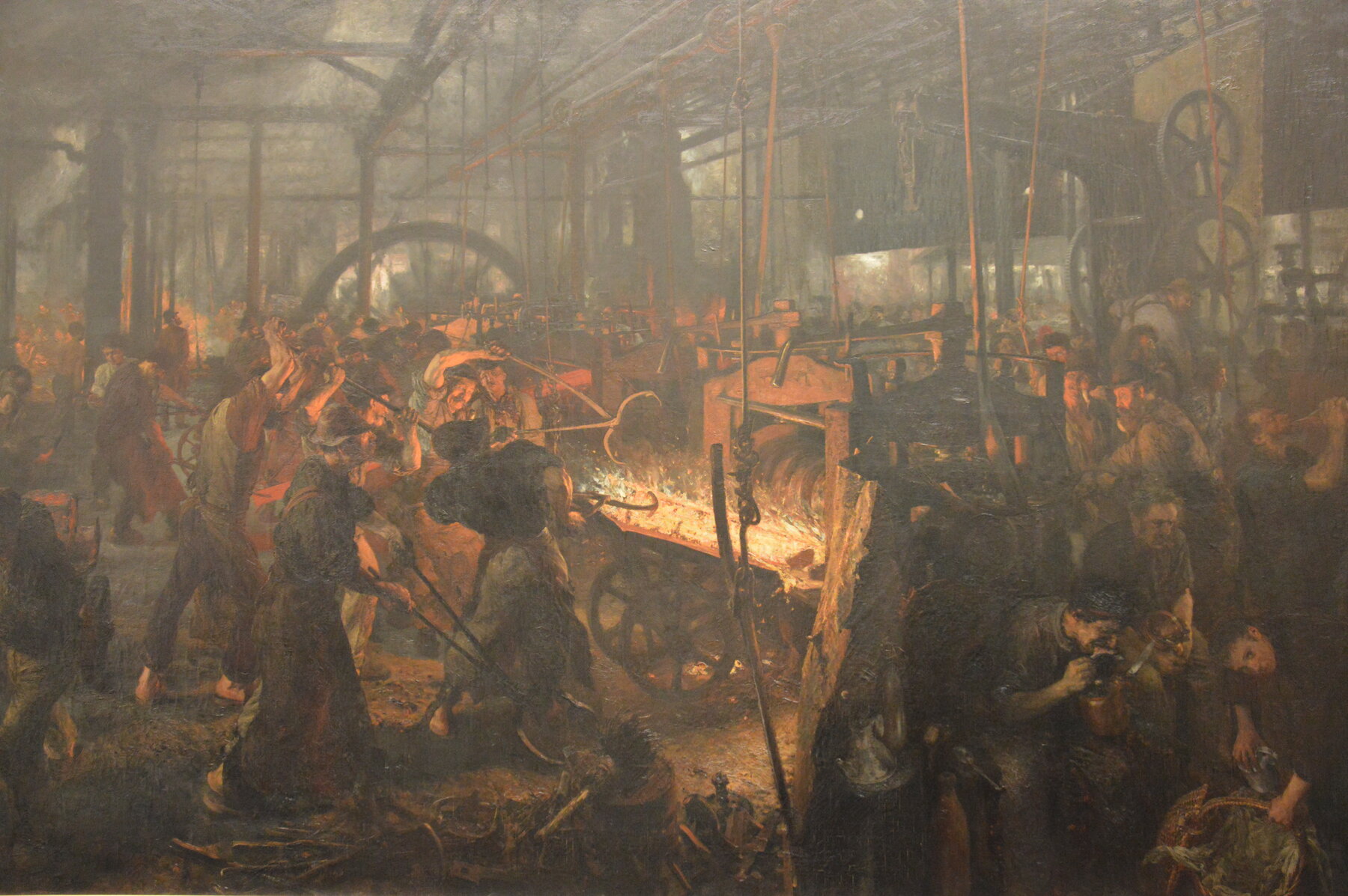
In the Chinese case, the problem is that supply outpaced demand. As an alternative example, consider the Industrial Revolution in Britain. The common narrative is that it was a supply-side event, driven by technological innovation and capital accumulation. The important thing was not invention in the abstract, but invention attached to a paying bottleneck2324.
23 The point of this section is not to adjudicate the historiography of the Industrial Revolution, which has been contested elsewhere (see for example Joel Mokyr, “Demand vs. Supply in the Industrial Revolution,” Journal of Economic History 37 (1977): 981-1008). Mokyr’s demand-vs-supply framing addresses the ultimate causes of the Industrial Revolution. My claim is about selection and scaling: many things can be invented, but only some become economically transformative. In Britain, textile demand, coal demand, mine drainage, and mill power created paying bottlenecks, which is why those particular technologies mattered.
24 The story is better recounted elsewhere, but I will do my best to retell it here.
25 The same supply chain explains Britain’s subsequent desire for cotton from the Americas. Wool was the original input, but the British later expanded their supply chain to include inputs like cotton, which proved to be cheaper and more versatile. Britain’s conquests in India also fed massive quantities of cotton into the same system.
Through the Middle Ages, one of the most important trade systems in Europe, textiles, ran through Britain. Wool shorn from sheep in Scotland and Wales25 moved south to England, where it was spun into thread and woven into cloth, then shipped to the Low Countries to be dyed and ultimately distributed across the continent. Britain was the center of textile production for much of the world, and the binding constraint on that production was spinning thread, which consumed the overwhelming majority of the labor and relied entirely on human hands turning wheels.
At the same time, Britain had largely been deforested, and had shifted to burning coal for heat. At first, the coal was mostly burned in homes, but as demand for coal grew, mines had to go deeper, which created a drainage problem. This created a paying use case for Newcomen’s steam engine, which was so fuel-inefficient that it was only useful when sitting directly atop a coal mine. Decades of pumping water out of mines created demand for more and more refined engines.
Meanwhile, the spinning jenny and its successors had already centralized spinning into mills and concentrated the work into a few sites, creating a power bottleneck that human cranking could not fill. The refined steam engine could drive the rotational motion those mills needed, and the textile industry was the paying customer waiting for it. Each individual link in the chain was motivated by a clear customer at the next step26.
26 It’s possible that what’s actually happening with demand is more of a selection effect, where many technologies are invented, but only those that meet a real demand survive and scale. In the case of the Industrial Revolution, there were many inventions, but only those that addressed the bottlenecks in the textile supply chain (like the spinning jenny and the steam engine) were adopted and scaled. In this way, we can liken natural selection to the supply chain process, and sexual selection to the demand chain process. In both cases, there is a vast space of possibilities, but only a subset of those possibilities are selected for based on their fitness (in the case of natural selection) or their market demand (in the case of the supply chain).
Demand Chains
The Industrial Revolution in Britain was driven by demand for textiles. The supply chain for textiles ran through Britain, with raw materials moving from Scotland and Wales to England, where they were processed into finished goods and distributed across the continent.
We can also think of a demand chain, where the demand for textiles in Europe created demand for thread in England, which created demand for coal in Britain (and for raw materials from the Americas, India, and Scotland). Demand for coal then led to demand for steam engines to pump water out of mines, which created demand for more efficient steam engines to power mills.
Supply chains are about physical flows. For an individual business, dealing with a supply chain is the question of “how do we get the product to the customer?” Supply chain optimization typically involves removing bottlenecks, improving throughput, and reducing costs. Supply can, of course, be limited by chokepoints. Furthermore, in the supply chain, value accretes as you move downstream. Raw commodities have low margins, refined products have higher ones, and branded finished goods capture the most value.
In contrast, demand chains are about informational flows. For an individual business, dealing with a demand chain is the question of “how do we get the customer to the product?” Demand chain optimization involves identifying and reaching the right customers, reducing search and switching costs, and creating feedback loops that convert weak intent into strong intent.
While less intuitive, demand can also be constrained. The same three filters from the previous section (discover, trust, pay) reappear here as chokepoints in the chain rather than conditions on a single want. If customers can’t identify the product or service, then even if the product is available and affordable, it won’t sell. If the channels through which customers discover and purchase products are limited by the rate of information diffusion (or controlled by gatekeepers), then access to demand may be restricted, creating bottlenecks that limit sales. If customers don’t trust the product or the seller, they won’t buy, even if they want it and can afford it. If liquidity is constrained, then customers may not be able to pay for the product, even if they want it and can access it.
The demand chain runs in the opposite direction as the supply chain. Value accrues wherever the scarce chokepoint sits, and in demand-constrained markets that chokepoint tends to sit near the customer interface, since that is where intent gets converted into purchase. The firm closest to the end consumer therefore tends to most shape demand and control pricing power, thereby capturing the largest margins27.
27 If you map the demand chain the way Porter mapped the supply chain, you get a value gradient that runs from need recognition (highest margin, most intangible) through search and evaluation to purchase (medium margin) to consumption and advocacy. The “raw material” of the demand chain is undifferentiated consumer attention. The “refined product” is a loyal customer relationship.
28 See also Ben Thompson’s “Aggregation Theory,” https://stratechery.com/2015/aggregation-theory/.
That’s why in modern society, value increasingly accrues near the customer interface. Search, identity, payments, distribution defaults, trust marks, and reputation systems all play a role in demand orchestration. The firms that control the demand chain have enormous power, even if they don’t produce anything themselves. For example, Google doesn’t make products, but it controls the search default slot, which is a critical chokepoint for demand. Apple doesn’t make most of the apps on its platform, but it controls the App Store, which is a critical chokepoint for demand. Amazon doesn’t make most of the products it sells, but it controls the marketplace and fulfillment network, which are critical chokepoints for demand28.
What makes these chokepoints so valuable is that demand is not a single transaction. Demand propagates. One demand can induce another.
Consider how demand for communication has historically developed. The desire to talk to other humans drove development of the smartphone. The smartphone produced demand for apps. Apps produce demand for developers, which produced demand for programming tools, cloud infrastructure, and ultimately electricity and data centers. A single root impulse fanned out into a cascade of derived demands, each one a market in its own right. We can think of this as “velocity of demand”, where small amounts of demand can multiply through derived demand chains, creating a compounding effect.
The Root of Demand
Most demand is, in fact, induced demand. Tractor companies buy software, but they don’t want software, they want to sell tractors efficiently, and the software they purchase helps achieve that goal. Farmers themselves don’t want tractors, they want harvests, and the tractor is induced by that prior want. The harvest, is induced by demand for food. Trace any purchase upstream far enough and you reach a small number of root desires. Humans want to be fed, sheltered, healthy, connected, entertained, secure, and esteemed. The demand for specific products and services is derived from these fundamental wants.
This brings us back to the question of AI. The bullish case for AI treats intelligence as a universal input. By making cognition cheap and abundant, demand expansion is assumed to automatically follow. But demand does not bottom out in “intelligence”. While AI might be extraordinarily good at producing the derived layers of the demand chain, those layers are only valuable insofar as they trace back to a root desire with a paying customer attached. How much of the world’s demand is actually bottlenecked by cognition? And even if all of the world’s demand is bottlenecked by cognition, how much is there left to really want?
Returns on Demand
AI promises to improve our production and make the supply chain more efficient by raising productivity, reducing costs, and expanding what can be produced. But at the same time AI is also a demand-chain technology. We can expect improvements in AI to also improve product discovery, trust, personalization, coordination, verification, payment, and execution. Better recommendation systems, lower search frictions, and more personalized matching of products to needs can all help improve the matching of supply and demand. Therefore we should expect AI to sit somewhere in the conversion from want to demand, and some of the economic effects of AI will run through demand conversion rather than additional supply.
What happens when you improve demand conversion? We can separate the effects of AI on demand into three cases:
- Expansion: The price of cognition drops, making services accessible to people or use cases where it was previously unaffordable. For example, maybe small businesses that couldn’t afford a lawyer gets contract review, or a student that couldn’t afford a tutor gets one. Existing supply is worth less money, but there is more available demand (as services are offered cheaper) so the supply expands to meet it, increasing value29. The catch is that even if usage expands enormously, the dollar volume can collapse, because price falls faster than quantity rises. If therapy falls from $150/hour to $5/hour, usage needs to rise 30x just to preserve the same revenue.
29 Strictly speaking, this is ordinary price elasticity, and in cases where cheaper cognition causes total cognition use to rise, it becomes a Jevons-style rebound.
- Compression. A more efficient demand chain eliminates intermediary layers that exist because matching is expensive. Recruitment agencies, ad platforms, market research firms, management consultants, middle managers, and many other roles exist because coordination is expensive. If AI does the matching better, the work still gets done. What shrinks is not the speed of demand, but the monetized surface area through which demand circulates. The chain becomes shorter, faster, and more concentrated30.
30 I think of brands as two types, supply-side and demand-side. A supply-side brand says “this was made well.” For example, Toyota vouches that their cars will run for 200,000 miles, Bosch vouches that their dishwashers won’t break, and Cravath vouches that their partners can handle your deals. A demand-side brand says “this is for people like you.” For example, a Rolex signals wealth, Supreme signals streetwear tribe, and PBR signals hipster identity. Supply-side brands are vulnerable to AI, since AI can certify production quality more cheaply. Demand-side brands are harder to displace, since coordination is not solved by making the underlying goods cheaper, so the surplus is harder to capture. This also relates to ideas from functional theories of art, where the value of art is not in the physical object, but in the social coordination it enables.
31 See also Citrini’s “2028 Global Intelligence Crisis”, Tyler Cowen’s response, and Eli Dourado’s comments linked there. A simple version of the demand argument is that automation displaces enough labor income that aggregate demand cannot absorb the resulting output, so the system runs into a demand wall. My claim is instead a marginal argument against automatic explosive growth. AI output can get bought, prices can adjust, and revenues accruing to AI owners do imply buyers somewhere with the ability to pay. The argument I’m making is about whether demand formation keeps pace with capability growth, which matters because singularity-style growth requires not only cheaper cognition but fast absorption of that cognition into new spending, income, institutions, and wants. AI revenue often comes from substitution rather than from new final demand, so if firms replace payroll, SaaS, legal review, recruiting, consulting, support, and management with a smaller amount of model and API spend, this leaves the buyer better off and the AI vendor richer while some of the intermediate incomes that used to generate derived demand elsewhere are reduced, displaced, or delayed. A long chain of paid human roles can become a shorter chain routed through fewer chokepoints, so measured capability can rise faster than the discovery, trust, payment, and income-distribution machinery needed to turn that capability into broad-based growth. The issue is not that AI output literally goes unsold, but that production can outrun absorption, and the composition of demand may change faster than the old income channels can adapt. In the long run, prices, incomes, institutions, and new categories of desire may rebalance. The concern here is that this does not follow automatically from cheaper cognition, especially on the timescale over which people, firms, debts, and communities actually live. The strongest reply is that AI will create new demand sinks we cannot yet imagine. I concede the possibility, since that is the creation case. The point is only that it is a substantive assumption, not something that follows automatically from cheaper cognition. In short, I’m not arguing that AI produces lots of stuff, machines do not spend, so demand collapses. I’m arguing that even if prices adjust and output is bought, the path by which demand propagates may become shorter, more concentrated, and slower to regenerate broad income, and that, generally, in the ultimate long-term, human demand will saturate on the margin.
AI also substitutes directly for existing paid cognition (coding, legal review, writing, analytics, design, support, tutoring, research assistance), which can create enormous consumer surplus while shrinking the dollar value of the market it disrupts. That substitution is bounded by the cost base it replaces, but the income removed from intermediaries does not automatically reappear elsewhere. This can be a genuine gain for consumers even as the dollar market shrinks, which means the danger is not lost usefulness but lost income circulation. This is not an argument against greater productive capacity, but against assuming that productive capacity automatically converts into explosive economic growth31.
Every friction is someone else’s revenue. Consider therapy as an example. If AI automates therapy, the consumer benefits economically, since an hour of therapy that cost $150 may now cost $5. The $145 difference stays with the consumer, and the therapist no longer earns the $150 they would have spent on rent, groceries, and other things. The question is not whether the saved $145 goes somewhere, but rather whether it goes somewhere that produces a new demand chain as thick as the one AI compressed. The consumer might spend it on a niche local service, or save it, or invest it, where it concentrates as financial-asset demand rather than circulating through restaurants, rent, and other broadly distributed channels. Automating the service satisfies the want and removes the income in one motion. This is the sense in which expansion and compression are often the same event seen from two sides, and the optimistic case tends to price only the consumer side. The unlocked want is also ultimately bounded, since cheap, abundant therapy eventually saturates demand the way cheap, abundant information and entertainment already have. If AI turns recurring labor income into consumer surplus and concentrated platform returns faster than new wants and jobs appear, welfare can rise while broad income circulation and measured growth disappoint.
- Creation. If, thanks to AI, we can make genuinely new things that people want that didn’t exist before (new drugs, materials, entertainment forms, diagnostic tools), then there is new demand that didn’t exist before. This is the strongest pro-singularity case. But AI does not, on its own, create new root desires. Instead, it might create new objects, routes, and institutions for satisfying existing ones. The desire for health, status, entertainment, and security is roughly the same as it has been since we were cavemen, but the ways we satisfy those desires has evolved.
The outcome of AI on demand depends on the ratio of these effects. If there is more expansion and creation than compression, the outlook is optimistic. On the other hand, if there is more compression than expansion and creation, the outlook is more pessimistic. The most likely outcome is that all three effects occur simultaneously.
If AI replaces labor income with capital income, and the relevant capital is compute, models, chips, energy contracts, data, and distribution platforms, then total output can rise while mass purchasing power weakens. The economy can become richer in aggregate while poorer in absorption capacity. Lower-income households tend to spend most of their income, so money in the hands of the poor tends to circulate more quickly. Money in the hands of capital owners is more likely to be saved or invested in financial assets. If the economy produces more, but the median household can afford less, the economy stagnates. Saving is not itself a problem when it funds productive investment, but becomes a demand problem when the surplus piles into asset markets, duplicated capacity, or platform rents rather than into broadly distributed purchasing power.
Historically the social contract rested partly on mutual need. Elites needed masses for labor, military manpower, consumer demand, and political legitimacy. AI systematically erodes the first three32, and consumer demand is the strongest remaining argument for why compute owners need a large population.
32 See my essay on AI and totalitarianism.
Attention is the parallel bottleneck created by abundance. Demand is not only about willingness to pay, it is also about discoverability and cognitive bandwidth. As supply of content and products explodes, attention becomes the bottleneck. Marginal returns shift from making better things to controlling discovery surfaces, such as ranking systems, ad platforms, identity graphs, recommendation loops. The scarce assets are pathways from intent to conversion rather than production capacity. This parallels a cultural saturation argument, where the theoretical space of possible cultural objects is astronomically large, but effective novelty is constrained by cognitive bandwidth. The overall consumption of cultural products is also bottlenecked by total time and attention available, which is finite.
AI may improve demand conversion while weakening induced demand. It may create more demand for cognition while compressing the chains that distribute purchasing power. The customer gets a cheaper service, the platform captures more surplus, and the economy loses some of the intermediate income streams that previously turned one root demand into many derived demands.
The Limit of Local Demand
Even if we solve income compression through redistribution, broader ownership, lower prices, or public investment, demand still must be ultimately rooted in human wants.
Earlier, we discussed China, which faces a demand shortage due to an oversupply problem. The problem is that the Chinese economy produces more than it can sell, resulting in deflationary pressure. In the West, the problem is not oversupply, but rather exhaustion of marginal demand.
The issue is not that Americans have nothing left to want, but that many remaining wants (housing, health, status, time, safety, belonging) are harder to satisfy with scalable commodity production. The basics that mass production can deliver have mostly been delivered, and informational and entertainment needs are abundant and cheap33. What’s left tends to be land-bound (housing), labor-bound, meaning the value is tied to a human providing it (healthcare, care work), positional (luxury, status), bureaucratic (credentials, risk reduction, compliance), idiosyncratic (personal-fit goods), or coordinative (public goods with conflicting preferences across the public). None of these respond well to adding more factories. No structural reform unlocks a hidden pool of demand that scalable commodity production can serve, because the demand that scales has already been served34.
33 In fact, information and entertainment is often free, and there is now so much content that attention is the scarce input and we may be approaching cultural saturation.
34 Readers might flag some exceptions. For example, if immortality pills were suddenly invented, they would likely be a hot ticket item. This is the “creation demand” case from the previous section. I’ll concede this point, since it’s essentially impossible to argue against. I can’t imagine what I can’t imagine. But it’s also intellectually unsatisfying. The argument amounts to taking on faith that some unspecified future breakthrough will arrive, which isn’t really an argument.

Both countries have similar symptoms due to different underlying economic root problems. China’s “lying flat” (tangping) movement is the demand-side consequence of its supply-side overcapacity. Young Chinese workers, facing diminishing returns to effort in a hypercompetitive economy, are opting out by working less, consuming less, and refusing to participate in the escalator of credentials and housing and children that previous generations treated as mandatory.
The West also has its own versions of these movements. Quiet quitting, the FIRE movement, declining labor force participation among prime-age workers, declining fertility, and a widespread cultural revaluation of work-life balance over income maximization all point to a broader shift in values and priorities. Birth rate declines are themselves a demand signal. Children are the largest purchase most people make, in time, money, and foregone opportunity, and a sustained contraction in that demand cascades through housing, education, healthcare, and consumer goods for decades. Goods available at the margin don’t feel worth the work required to obtain them. This connects to the secular stagnation hypothesis. If the high-return economic opportunities (basic industrialization, electrification, mass consumer goods) have already been captured, then what remains is inherently lower-return. Capital and labor flow into compliance, credentialing, financial engineering, and administrative coordination, not because these are highly valued, but because there is nothing better left to produce that gives a good return. The economy grows, but the marginal unit of GDP is worth less to people than the previous one. If this thesis is correct, we should expect continued weakness in fertility, youth labor-force attachment, and other forms of economic buy-in.
Demand for Demand
If the diagnosis I’m arguing is correct, then supply-side fixes alone are insufficient (and in fact may exacerbate the problem in the short term). How can demand be increased?
The first lever is to broaden purchasing power. If AI concentrates income among compute owners and model providers, this could compress demand, since money concentrated in the hands of capital owners is more likely to be saved or invested in financial assets. Money in the hands of lower-income households, by contrast, is more likely to be spent and circulate. There is also a more basic welfare point. The marginal value of money diminishes as you have more of it, so distributing income gives more total value than concentrating it. In an AI economy, broadening purchasing power may require broader capital ownership, AI dividends, sovereign AI funds, public stakes in frontier infrastructure, data or compute royalties, transfers, or lower housing, health, or education burdens. A public or commons AI stack (open models, open compute, public data commons, sovereign infrastructure) is one route to the same end, since it gives surplus somewhere public to flow rather than fully concentrating in private platforms. Taxation of the AI capital stack is another. Compute, frontier training runs, model API fees, data exchanges, and platform take rates can all be levied on, with proceeds going into the public stack or into direct redistribution. The deeper point is that demand policy cannot merely subsidize consumption after the fact. We would have to distribute claims on the productive system itself.
The second lever is to break up monopsonies on demand. Compressed demand chains do not vanish, but instead concentrate at a handful of platforms that now own the conversion path between intent and purchase, such as App Stores, search default slots, ad platforms, identity graphs, frontier model APIs, and cloud compute oligopolies. Each functions as a monopsonist over the sellers and producers feeding into it, and if those chokepoints go uncontested, the surplus from compression locks in. The platforms may lower some prices, but they can still harm consumers by reducing diversity, steering discovery, extracting rents from sellers, or locking users into a controlled demand channel. The response is antitrust on the new platforms, mandatory interop, mandatory data portability so users can move attention and history across platforms, and regulation of bid floors or take rates where the platform has monopsony power over its sellers. The point is not to preserve the old intermediaries, but to keep the new ones contestable so the surplus does not concentrate without competition.
The third lever is to expand wanting for idiosyncratic things, and hence associated demand. The consumption that would actually be worth doing at the margin is personal and weird. Someone wants to consume a niche novel, own unique furniture, listen to strange music, etc. This is the demand that remains after standardized consumption saturates, and the conditions that produce it are cultural and environmental more than economic. Cultural infrastructure (independent media, public broadcasting, niche scenes, festivals, small publishers) makes idiosyncratic possibilities visible enough to want. Education that creates capacity for distinct desire is important too, since someone with mental categories for music theory, woodworking, herbalism, or astronomy can want things that someone without those categories might not be aware of. Community and belonging structures (scenes, congregations, clubs, guilds, lineages) shape what people want, since people want what their group values. Diverse community is therefore important in developing demand35. Aspirational visibility of diverse life paths matters because visible aspiration currently runs one shape (rich, urban, credentialed), and surfacing more shapes (farmers, craftspeople, scholars, eccentrics, tradesmen, religious lives) creates more shapes of want. Long unstructured time gives wants room to form in slow undirected stretches rather than in optimization mode. Travel and cultural exchange expose people to wants they couldn’t have wanted before. Underneath all of this, cheap foundational goods (housing, healthcare, education, energy, transportation) and reduced friction on starting things create the discretionary space for these wants to land. They do not, by themselves, create wanting.
35 One explanation for the hollowing of the art middle class is the loss of geographically local experts. The world has been folding into a single global market. In a geographically distributed society, the quality power law is gentler, since being the best band in your town can still pay rent. Cheap communications erased that buffer. Whatever the top of the global pile is now competes directly with what’s down the block, and the local stuff loses. Maturing artists and experimental local genres (the California surf rock or NYC Salsa kind of thing) lose their incubator. If you aren’t already the best, there’s nowhere to grow. The bottleneck has shifted from how content reaches people to how people find it, and search funnels attention toward the global top. The system is more efficient in aggregate, but the rent now flows to platform owners instead of local venues and artists. Variety has been traded for efficiency. The counterexample is instructive: lower-class Chicago neighborhoods still produce rap music disproportionately, because the local community is intact enough to act as an incubator and an audience. Where community is intact, distinctive local art still gets made and demanded.
Conclusion
Human technology and production capacity have grown for millennia, producing numerous marvels that would have been indistinguishable from magic to our ancestors and providing material abundance to modern consumers. AI promises to accelerate that growth, but the question is: to what end?
The economic problems of the past were about production. How do we make enough food, iron, or cars? The 21st-century problem is absorption. How do we find trusted buyers for all this stuff? How do we coordinate across demand chains? How do we find new products people want when they already have so much?
AI may be the largest supply shock since the industrial revolution. Historically, we can see that cases where demand preceded supply (such as Britain’s coal demand) led to self-reinforcing loops of growth, while cases where supply outpaced demand (China’s overcapacity) can lead to stagnation and retrenchment.
In fact, in some places we are already living out trends associated with demand constraints, and AI threatens to accelerate them. Economic inequality concentrates purchasing power at the top where marginal consumption is low, human attention is saturated, coordination to meet conflicting demands has grown more difficult, firms are strip-mining trust for short-term margins, and many people are opting out of the economy by choosing to stop wanting more.
AI promises to make us extraordinarily productive, but the economy is fundamentally about achieving human desires, not just producing goods. Economic growth from AI is not automatic if we fail to make it serve human ends.
AI Disclosure
I used AI to help research, draft, and edit this essay.