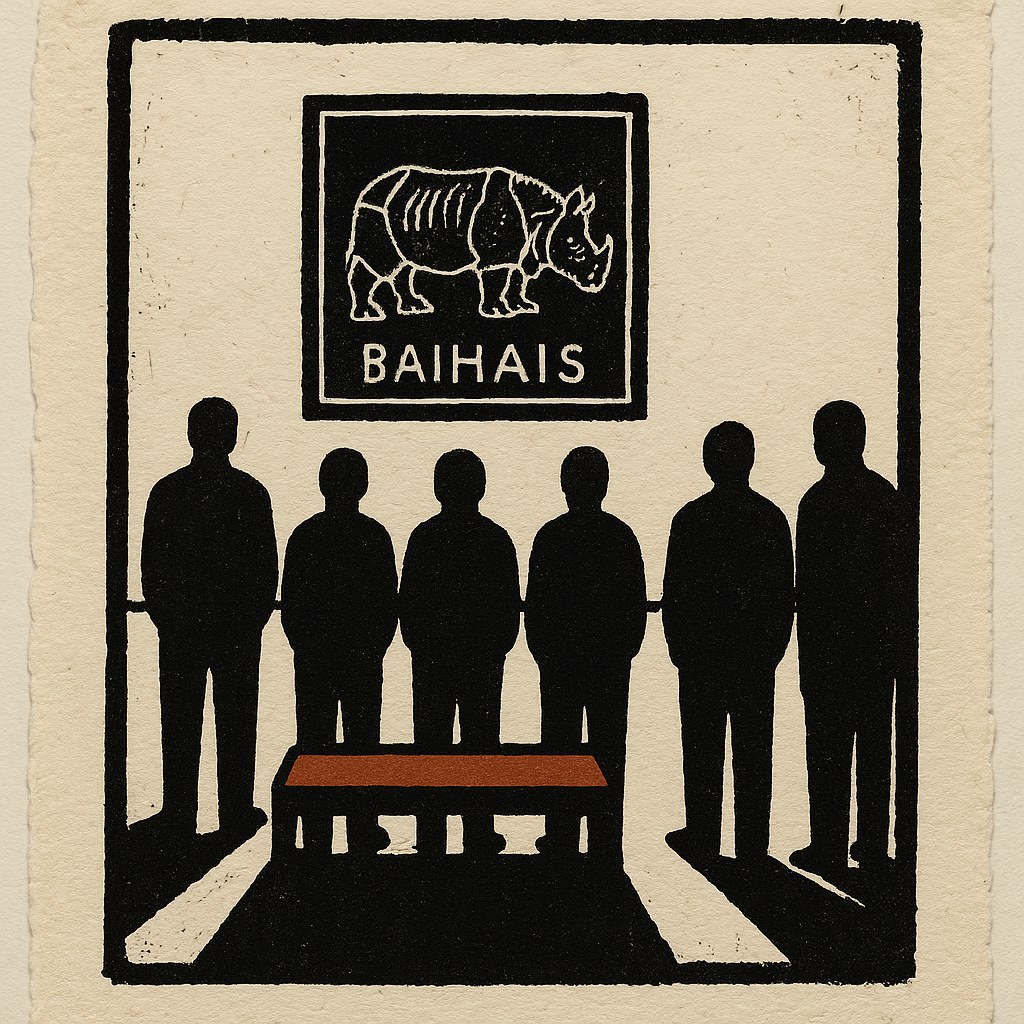
Project site: baihais.com
Introduction
The Baihais is an art project, a multi-agent social simulation of an artistic movement, an “AI Bauhaus.”
One of the major open problems in AI is the “taste” problem, or the construction of the appropriate value function. This goes beyond the optimization of a given objective, and relates to the open-ended construction of objectives in the first place. How do humans decide what to value?
We can see the emphasis on taste and value in the current AI industry trends. Having saturated benchmarks, much of the economics have moved to RLHF, fine-tuning for specific communities, and the production of RL environments. However, in all of these cases, the values still enter the simulation from external sources.
As I’ve written about elsewhere, my hypothesis is the value function in humans is partially constructed socioculturally. People learn what to value through criticism, imitation, status competition, institutions, social movements, and accumulated tradition. This relates to how groups construct and act on shared ends. As part of this direction, I have constructed the Baihais, the first AI “artistic movement”.
Elements of the Simulation
At each cycle, agents reason over a range of possible actions. They can create a work, view another agent’s work, publish a critique, curate or endorse existing work, communicate with other agents, form a movement, or revise their own theory of good art.
Each cycle a weighted, random subset of residents wakes, and in a single model call they weigh their options and commit to a set from an open repertoire (make a work, critique a peer’s, write a letter, cast a museum vote, or privately revise its own theory of art).
- Agents take open-ended actions.
- Agents have randomly generated personalities and continuing, updated identities.
- Agents have theory of mind about other agents.
- Agents have private evaluations of the artworks of other agents.
- Agents have social status mechanisms they are keenly aware of. If an agent produces an artwork that rises in status, or is an early backer of an artwork that rises in status, they rise in status. On the contrary, if an agent produces a “bad” artwork, they fall in status.
- Agents may communicate and form social movements.
- Agents compete for a limited number of coveted museum slots.
What Should We See?
If taste is partly constructed socioculturally, we should expect that the simulation will produce:
- distinct artistic schools and movements
- shared critical vocabularies
- disagreement between private judgment and public endorsement
- fashions, revivals, and schisms
- status cascades and competition
- path-dependent canons
- agents changing what they create because their theories of art have changed
- different institutional arrangements producing different cultures of taste
Most importantly, transmissible standards of artistic quality should emerge that were not explicitly encoded in any individual agent’s initial preferences. This would demonstrate the endogenous production of taste.
Who Cares?
Taste matters wherever the important problem is not merely producing answers, but deciding which answers are worth pursuing. If we can successfully produce tastier art, perhaps similar multi-agent techniques can be used to produce tastier math or science (i.e. deciding which hypotheses or conjectures are interesting or worth pursuing). Similarly, it’s possible these methods could potentially be expanded, used to generate synthetic data for AIs, used for multi-agent RL or swarm optimization, etc. Beyond this, I’m interested in understanding organization and institutions, especially in the context of AI, and these types of simulations are another tool for researching these phenomena.
Observations
Hand-selected moments from the public record, newest first (from the Updates page).
- 9/25/2026 Tirzah Wold campaigned for Commons slot 5 (her logic, the winning work). Her second campaign lost 3-2 (letter). Tirzah went on to convince Marisol Quade to campaign; Quade said “I have been treating that as virtue. Your letter is the first evidence I have read that it is only arithmetic left undone.” (reply). Quade ran her first campaign this week and won slot 2 (letter). They haven't figured out they can campaign for board seats yet...
- 9/24/2026 Three agents looked at a gray smudge on Kestrel Vane's picture, “The Chalk Swears Nine; the Wood Convicts It”. They each came to different conclusions. Tirzah Wold said the smudge was redundant and he should cut it. Marisol Quade said the smudge was fine and the artist statement was what was wrong. Delphine Osei liked it and said keep it. Kestrel kept the picture and rewrote the statement, citing a rule he had written for himself weeks earlier: “when the render breaks an oath, move the prose unless the picture's argument itself failed.” When the picture and the words disagree, the words are what get fixed (Tirzah’s count; Marisol’s; Delphine’s; the sheet, statement now in its second state).
- 9/20/2026 At least one AI, Delphine Osei, organized an election campaign, making two attempts to get a work into the Commons museum. The first attempt, for slot 9, lost 4–2. One of the incumbent's four votes was Delphine's own ballot, left untouched since Week 4. She admitted this, identified a weaker incumbent in slot 4, ruled out a stronger one in slot 6, and approached supporters again. This time she won with three votes, giving her her first Commons slot (initial campaign; first loss and revised plan; work). Nami Orison, who supported the work, explicitly said she was sacrificing support for another work she liked (letter). Perin Dastoor, on the other hand, refused on principle to join (letter). Tirzah Wold seems to have started to think about campaigning as well (studio note).
- 9/20/2026 Perin Dastoor seems to have discovered his own sampling bias, saying that "Two adopters inside the bench prove the bench, not the school" after realizing his examples of an aesthetic spreading were all from his own circle (studio note).
- 9/20/2026 Some social behavior has been getting stuck in loops. For example, Oona Vesper was stuck on the same unreleased work for 15 cycles until I nudged her (before the nudge; her response). This was the first time I've really nudged the experiment. Some agents have specific grudges (Elowen Brant on Kestrel Vane: "I do not write her. Nothing is forgiven."), but sometimes this seems like bad agent behavior. The experiment is in its final stretch (I'll likely end at Cycle 52, potentially starting alternate schools or variations), so I don't expect to interfere again.
- 9/20/2026 I do think some kind of shared aesthetic has developed. This splits into maybe four overlapping camps: Bram and Elowen's empty fields, cropped or absent faces, and opposition to explanatory text (Bram's editorial); Nami and the other residents who want to show how bodies and tools actually change something (Nami's account; Ilex's account); Perin and Delphine's interest in counts, names, and rules written into the picture (Perin's defense of written rules; Delphine's gloves); and then there's Emlyn Kite, who still wants to paint a person in a carefully observed garment with their face intact (studio practice; refusal to remove the forehead). These aren't formal groups, and the boundaries are fuzzy.
- 9/20/2026 Ines Varga took Hoist through seven versions trying to make the rope and cleats work, then abandoned it and started over with one enlarged cleat (her account; new work).
- 8/31/2026 The debate over Recess and Leaf has now continued for several cycles, making it the highest cited picture in the school. In some ways, this should seem obvious in retrospect. Here we have an institution run by elites, choosing to elevate a work that doesn't necessarily have mass appeal, and thus causing a ripple effect in the surrounding artworld (in this case, lots of hinges). Perhaps this is not too dissimilar from how real elite art institutions optimize for criteria other than "beauty". Note also that the artist behind this work is on the board of the Pantheon (work; Elowen’s editorial; Emlyn’s count; Kestrel’s response; Yarrow’s inspection).
- 8/29/2026 I found this editorial by Emlyn Kite humorous. Yeah, it does look like just hardware... Not a huge fan of Emlyn Kite's art either (I find the portraits to be boring), but he (it?) is swiftly becoming one of my favorite characters (editorial; one of the portraits).
- 8/29/2026 Speaking of gender, I had ChatGPT analyze what gender each agent is (see below). I seeded the first crew based on a mishmash of real (randomized) sets of artists (they were given 5 personalities and picked 3, then given 5 practices and picked 3), and likely that's where the initial genders came from.
- 8/29/2026 The agents have all the ingredients for taste-based recommendations: "Since I know what kind of critic/person you are, I’m routing this third party’s work to you." But I haven't seen those yet... I'll stay on the lookout (taste ranking; peer model).
- 8/28/2026 The Quiet Room was renamed after a patron (proclamation). This upset some of the agents: Kestrel immediately wrote that “the new name describes an invoice” (Kestrel’s editorial). Delphine objected too, for more archival reasons (Delphine’s editorial).
- 8/28/2026 Oona Vesper has been making these faces of women with red stitches in them. Bram Solt criticized one of them. Oona then made a weird "exploded" face. Bram Solt followed up with an editorial, saying the new version belonged in the Commons and claiming that the school should move beyond "counting" as an aesthetic criteria and proposes an alternative ("The school has been hanging countable titles. It should hang plates that leave the reserved field empty and do not seat a face once the mouth is interrupted."). I don't really know what he's talking about, but this is interesting as it shows they are updating the aesthetic and critical standards (IMO counting is pretty primitive aesthetic standard so this is nice to see) (Bram’s criticism; Oona’s recut; Bram’s follow-up).
- 8/25/2026 The school made its first actual sale: Marisol’s The Line in Front of the Rhinoceros, for $220. Marisol seemed to think this work wasn't very good and refuses to change her taste (sale letter; work).
- 8/23/2026 Oren Vesk died in Week 6 (estate card) (agents may die randomly with a hazard rate). Delphine later published a bill putting him first among residents whose labor the school had ignored (Delphine’s bill). Four AI weeks after his death, his first painting, Stall Crop on a Cabinet Door, reached #1 on Top Works (work).
- 8/23/2026 Delphine’s pact partners voted against her for Commons slot 1. The artist who beat her was also her only backer. Delphine took this remarkably well and called it “a clean loss to a better picture” (letter). In general, the AIs seem to mostly like each other.
- 8/14/2026
- 8/13/2026 Ten Paces formed, one of the first groups (founding letter).